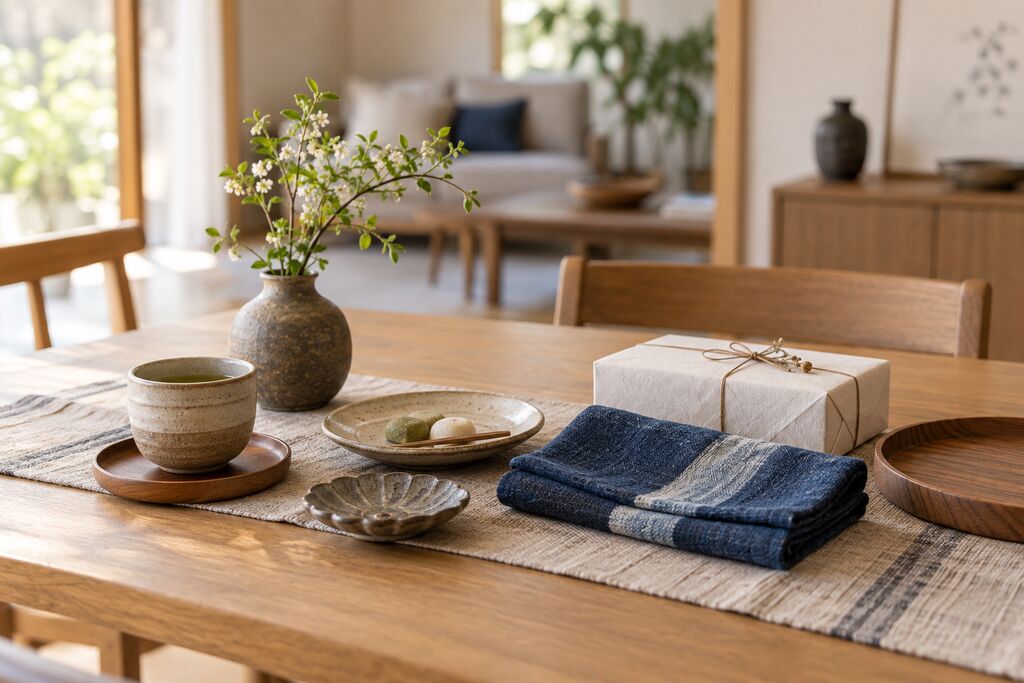
How to Bring Japanese Craft into Everyday Life
Japanese craftsmanship is often presented as something precious, formal, or reserved for special occasions. In reality, many traditional objects were made for ordinary life: bowls held every morning, cloth wrapped and reused, trays carried from room to room, and small objects placed near the entrance to welcome good fortune.
The easiest way to understand Japanese craft is not to begin with a list of techniques. Begin with an object you will actually use.
Start with the rhythm of your own day
Look at the moments that repeat: making tea, setting the table, getting dressed, or arranging a quiet corner at home. A handmade object feels most natural when it joins an existing habit rather than asking you to invent a new one.
A ceramic cup can change the texture of a five-minute break. A woven cloth can become a table accent, wrapping cloth, or wall display. A small kimekomi object can bring color and seasonal character to a shelf without turning the room into a museum.
Choose a category that is easy to live with
Tableware
Bowls, plates, cups, and serving pieces are a welcoming first step. Subtle variations in glaze, shape, and weight are part of the maker’s hand. Choose a size that fits the food you already cook, then let the object become more familiar through use.
Textiles
Japanese textiles are flexible by nature. Tenugui cloth, furoshiki wrapping cloth, and woven fabrics can move between practical and decorative roles. They are also easy to introduce into a modern interior because they add pattern and color without taking up much space.
Small objects
Incense holders, maneki-neko, kimekomi pieces, and compact decorative objects are ideal when you want a meaningful detail rather than a major change. Their cultural background gives them a story, while contemporary forms allow them to sit comfortably beside books, plants, and modern furniture.
Look beyond perfection
Handmade work carries small differences. Two pieces may share the same design but vary slightly in tone, surface, or expression. These are not defects; they are evidence of material, process, and the decisions of a human maker.
Instead of asking whether an object is perfectly uniform, consider how it feels in the hand, how it catches light, and whether its story makes you want to keep it close.
Let one object lead to a deeper story
Once an object becomes part of your life, questions follow naturally. Where was it made? What local materials shaped it? Which skills must be passed to the next generation? This is where craft becomes more than decoration. It becomes a relationship between a place, a maker, and the person who uses it.
At KURASHiNOwa, we share these connections through contemporary storytelling, collaborations, and objects selected for modern life. Our aim is not to preserve tradition behind glass, but to help it keep moving.
A simple first step
Choose one object for one recurring moment. Use it often. Notice how it changes with time—and how your attention changes with it.
If you would like to explore pieces made by Japanese artisans, visit our online shop. Each object is an invitation to discover the people, places, and techniques behind Japanese craft.