A wooden screen can look almost weightless: a few pale lines, then a whole field of stars. Look closer and the puzzle changes. Those lines are separate pieces of wood. Where are the nails?
In Japanese kumiko, the answer lies in the fit. Carefully cut joints connect the framework, while smaller, angled pieces fill its spaces. Geometry gives the parts somewhere to sit; precise woodworking makes them stay there. But “without nails” needs one qualification: it does not always mean “without glue.”
What exactly is kumiko?
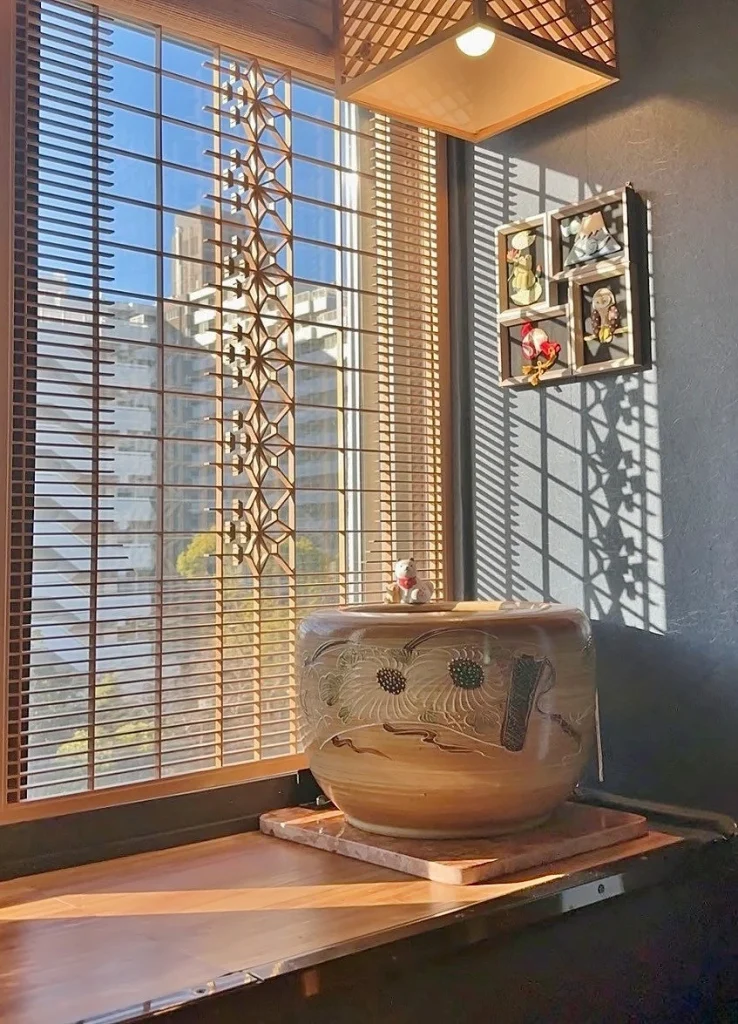
Kumiko is decorative wood lattice assembled from slender strips. You may see it in sliding screens, room dividers or the panels of contemporary furniture. Unlike a pattern carved out of one board, it is built piece by piece. Light passes through the openings, making the empty spaces as important as the wood.
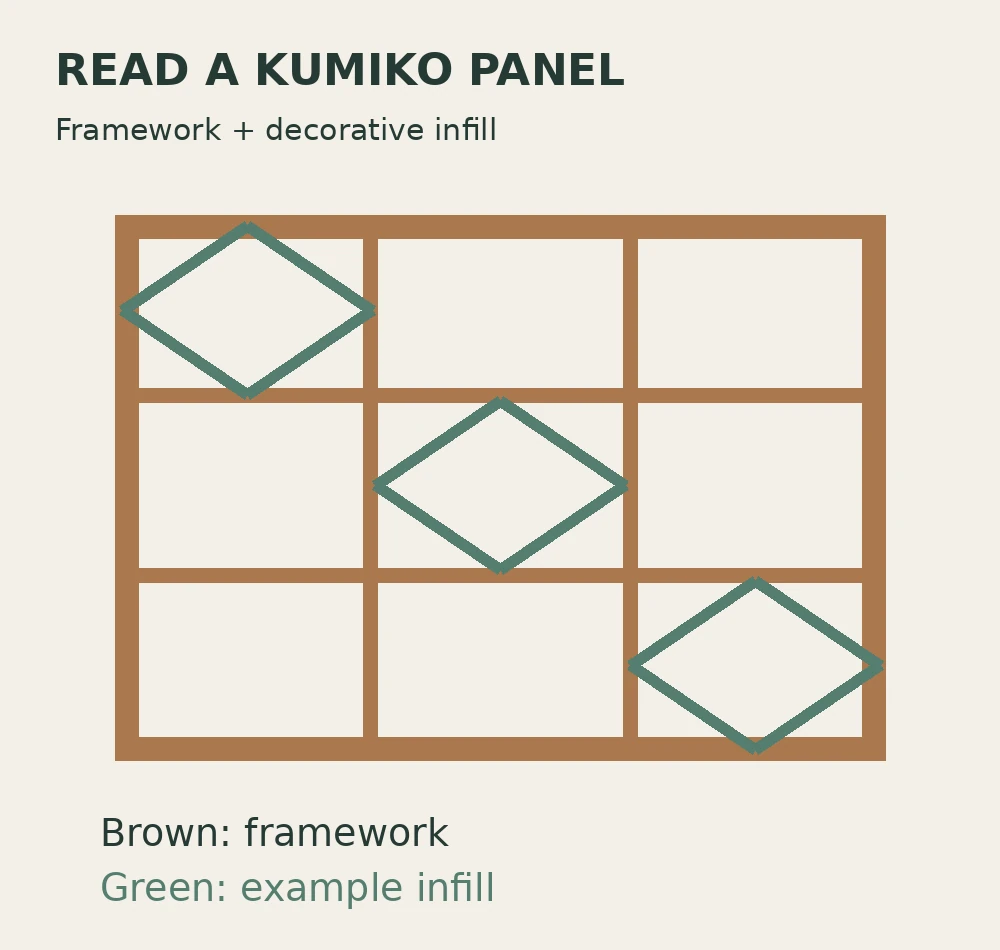
A useful way to read a panel is to separate its underlying grid from its decoration. The Fukui furniture and joinery cooperative describes the basic framework as jigumi and the smaller decorative pieces as ha-kumiko. A square grid, a diamond grid and a triangular grid give makers different starting points. The star you notice first may sit inside a much simpler supporting structure.
How do the pieces hold together?
The framework provides the first connections
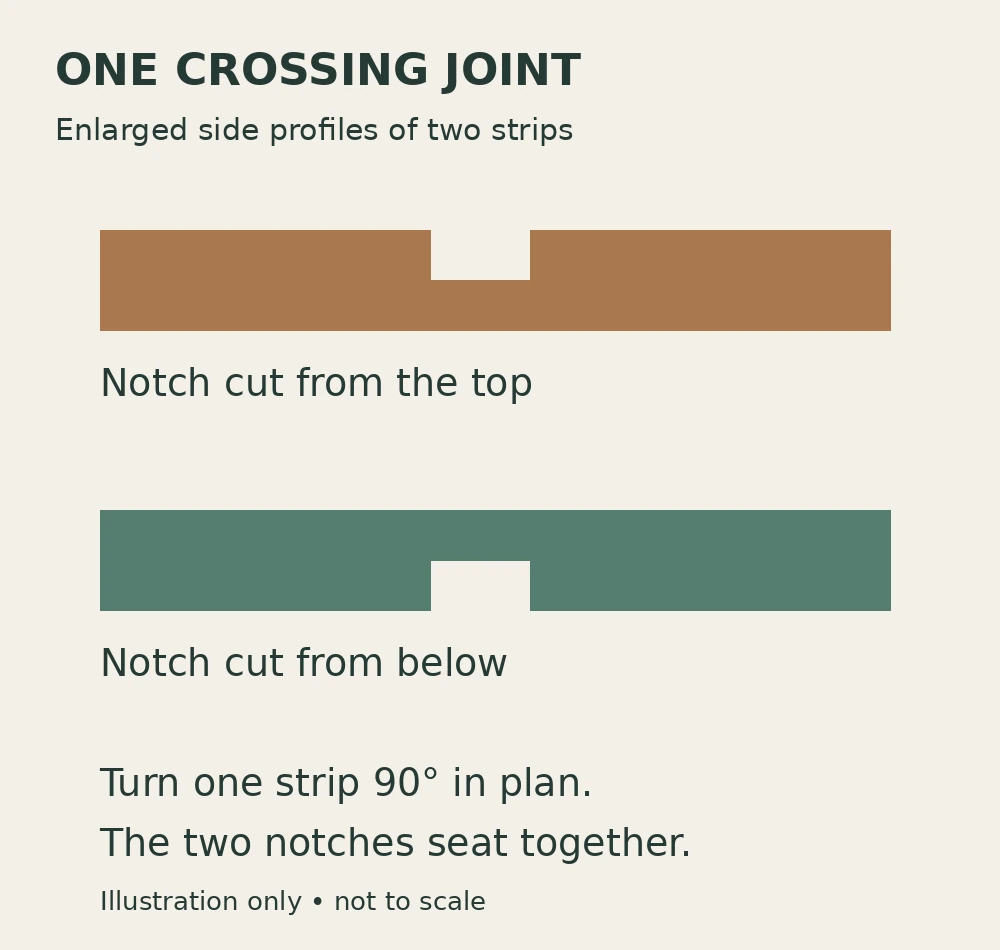
In a simple crossing joint, each strip can be notched so that another strip seats into it. Think of two combs meeting, rather than two sticks laid loosely over one another. The shoulders of the cuts locate the pieces. Many such connections form a repeating framework, which is contained within the panel’s outer border.
That is one simplified example, not a universal recipe. Makers use different grooves, notches and small projecting joints according to the design. A photograph of a finished panel rarely reveals every connection, so a beautiful lattice should not be treated as a construction plan.
The infill depends on angles and length
Inside each opening, small pieces meet the framework and one another. Their bevelled ends need to land where the pattern expects them. A piece cut too short leaves a gap; one cut too long cannot simply be pushed into place without risking damage. Multiply that small error across a panel and the pattern soon loses its rhythm.
This is why “it stays together through pressure” is an incomplete explanation. The shape of the joints locates the wood, accurate surfaces meet, and the surrounding assembly constrains movement. It is fitted joinery, not a heap of strips squeezed until it behaves.
Does kumiko ever use glue?
Yes, some does. Toyama maker Tanihata’s explanation of its process says that small amounts of adhesive are used when assembling the decorative leaves. Other makers offer particular assemblies that fit without glue. The material, pattern and intended use matter.
So ask two separate questions when looking at a piece: are metal fasteners used in the lattice, and is adhesive used anywhere in its assembly? Neither answer can safely be inferred from the phrase “traditional Japanese woodworking.” The wider door, cabinet or building also has its own construction; a nail-free decorative panel does not make the whole structure nail-free.
Why do the patterns require so much preparation?
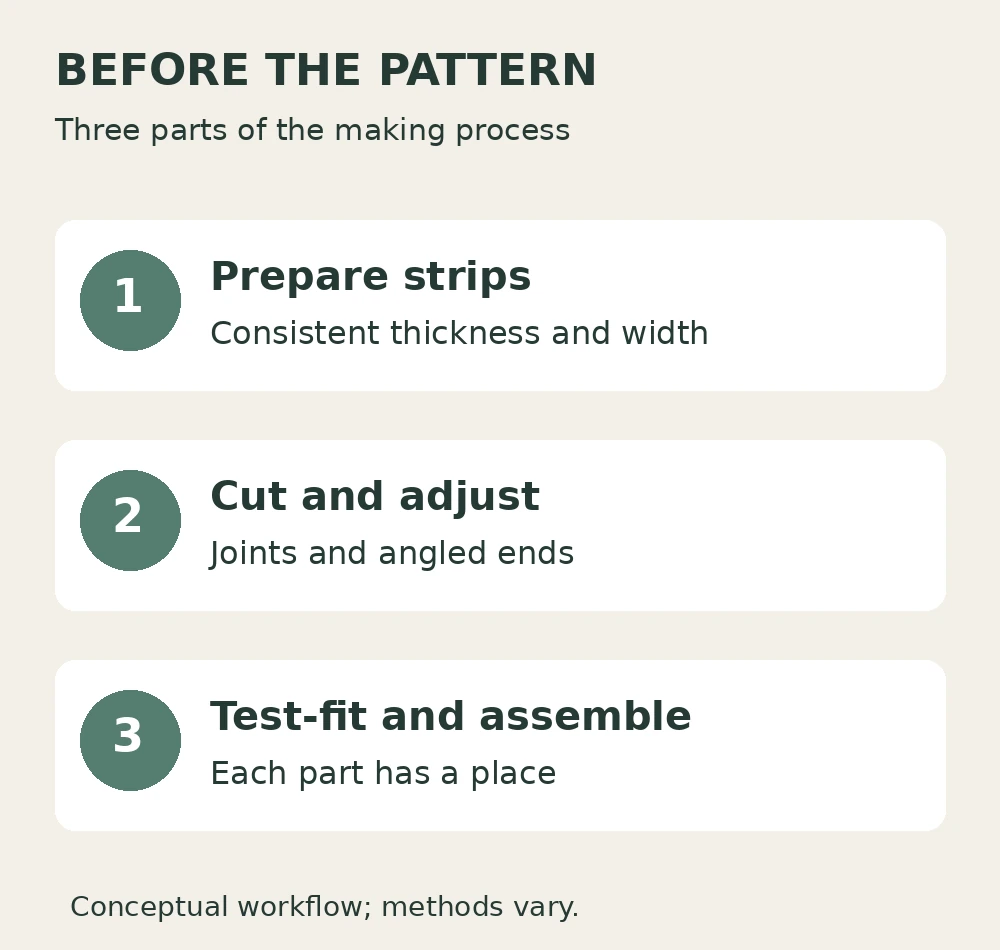
Before the satisfying moment of assembly comes the less visible work: preparing consistent strips, making repeated cuts and checking the fit. Tanihata describes using planes, saws and chisels to adjust its parts, and selecting straight-grained wood carefully. A knot or a tendency to twist is a serious issue in such thin material.
Repeatability is the demanding part. One neat joint is pleasing; a hundred joints that meet with the same clean line create a panel. The maker has to think about both the small connection under the tool and the larger field that the viewer will see.
Asanoha, the hemp-leaf pattern, is a good place to start looking. Its pointed geometry is built around a repeated triangular arrangement. Trace one complete unit with your eyes, then find where it begins again. The Fukui cooperative’s process explanation shows how particular angled parts build that design. What reads as a star from across the room resolves into separate components up close.
An old technique with changing uses
Accounts of kumiko often reach back to early Japanese temple woodworking. That long background should not make every intricate pattern seem equally ancient. Tanihata’s account of kumiko traces its roots to the Asuka period, long before the intricate patterns familiar today. Regional workshops also have their own histories.
Today, a lattice can divide a room without making a solid wall, soften a bright opening or become the face of a lamp. In an interior, look at what the light does through the panel as well as at the pattern itself. Move a little to one side: the depth of the strips changes the view through them.
Where can you see or try it in Japan?
Kumiko-za, the Toyama Craft Lounge near Toyama Station, offers displays and making experiences, and welcomes visitors who simply want to look. Check its current opening information and book ahead for a workshop. Ask which sessions are available in a language you understand.
For a first attempt, a supervised activity with prepared pieces lets you concentrate on assembly. It also reveals what a finished object hides: those tiny parts do not all feel interchangeable. There is satisfaction in finding the orientation that lets one settle neatly into place.
At your next encounter with kumiko, start with a single crossing, then follow the surrounding pattern. The mystery becomes legible without becoming less interesting. You are looking at a design whose smallest connections have been thought through.
Featured photograph: Manish Prabhune, Kumiko Panel – Light and Shadows, CC BY-SA 4.0. Resized and converted to WebP; this image adaptation retains that licence. Diagrams: KURASHiNO和 JOURNAL. Research checked November 7, 2026.